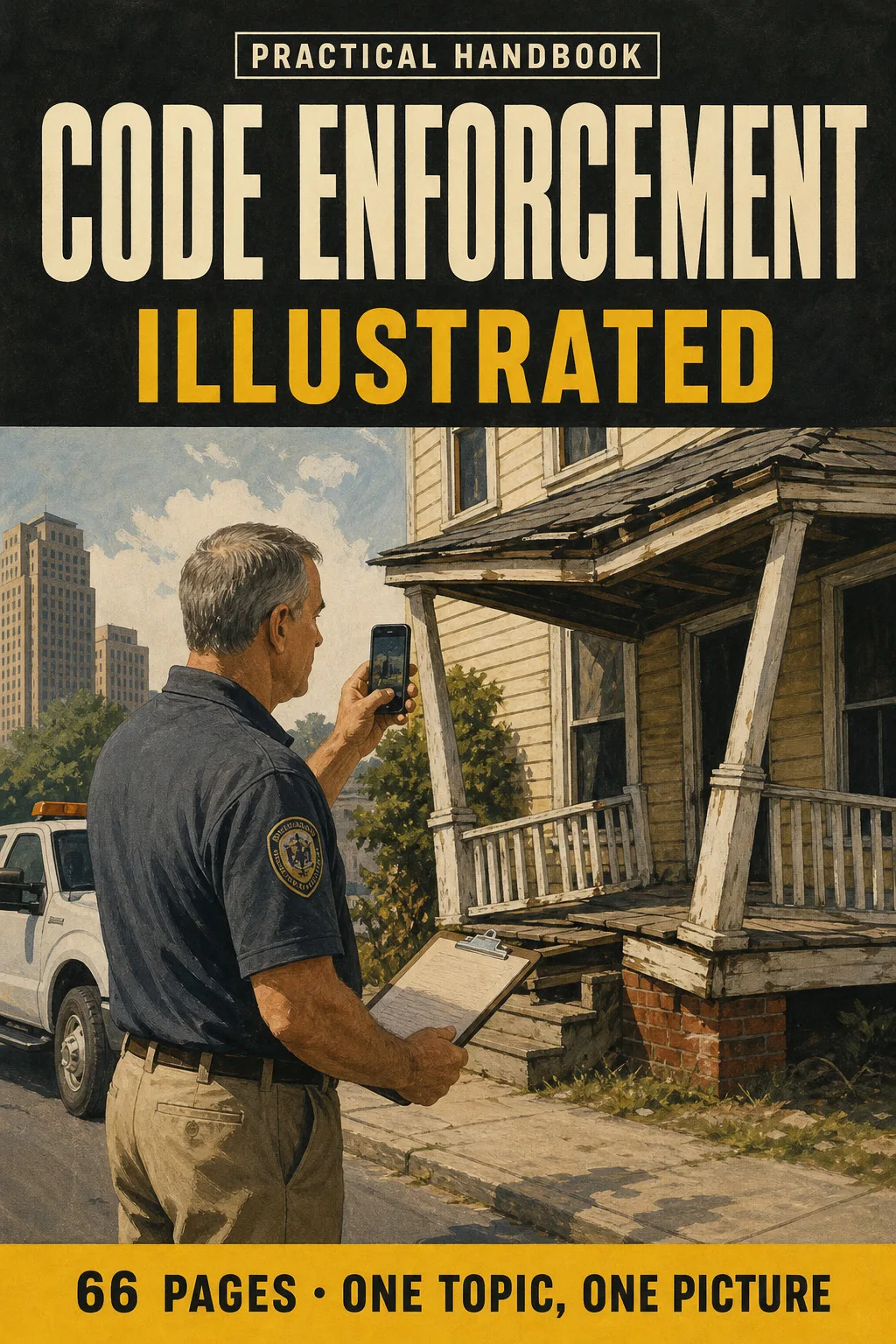
📄 Digital book in PDF · read it on your phone or print it
Exterior property, unsafe exterior conditions, light and occupancy, plumbing and heat, egress, smoke alarms, right of entry, notices and hearings. Every topic gets its own page: the drawing first, then what you need to remember. 66 illustrated pages.
🔒 Secure checkout · PDF by email · 30-day guarantee
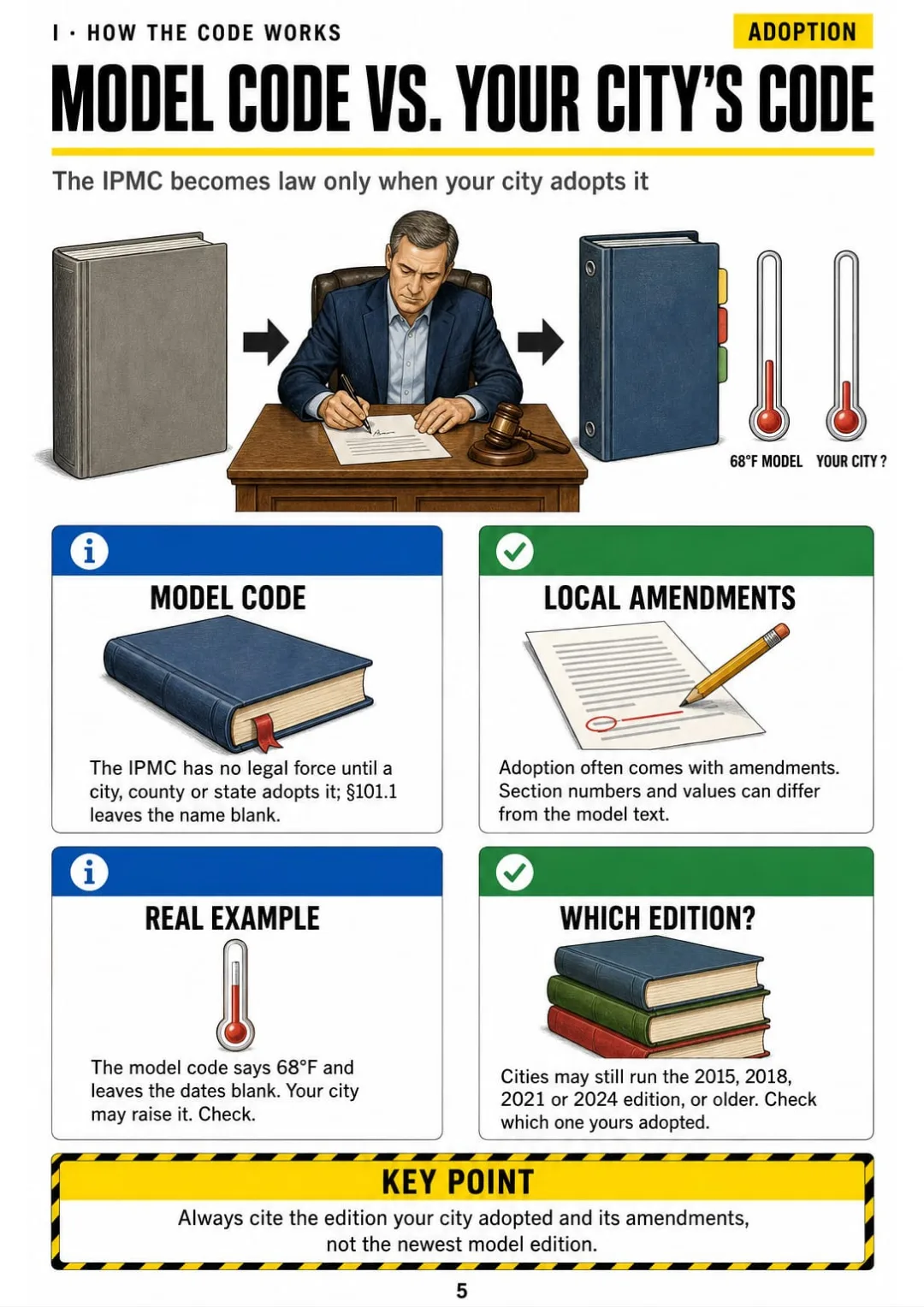
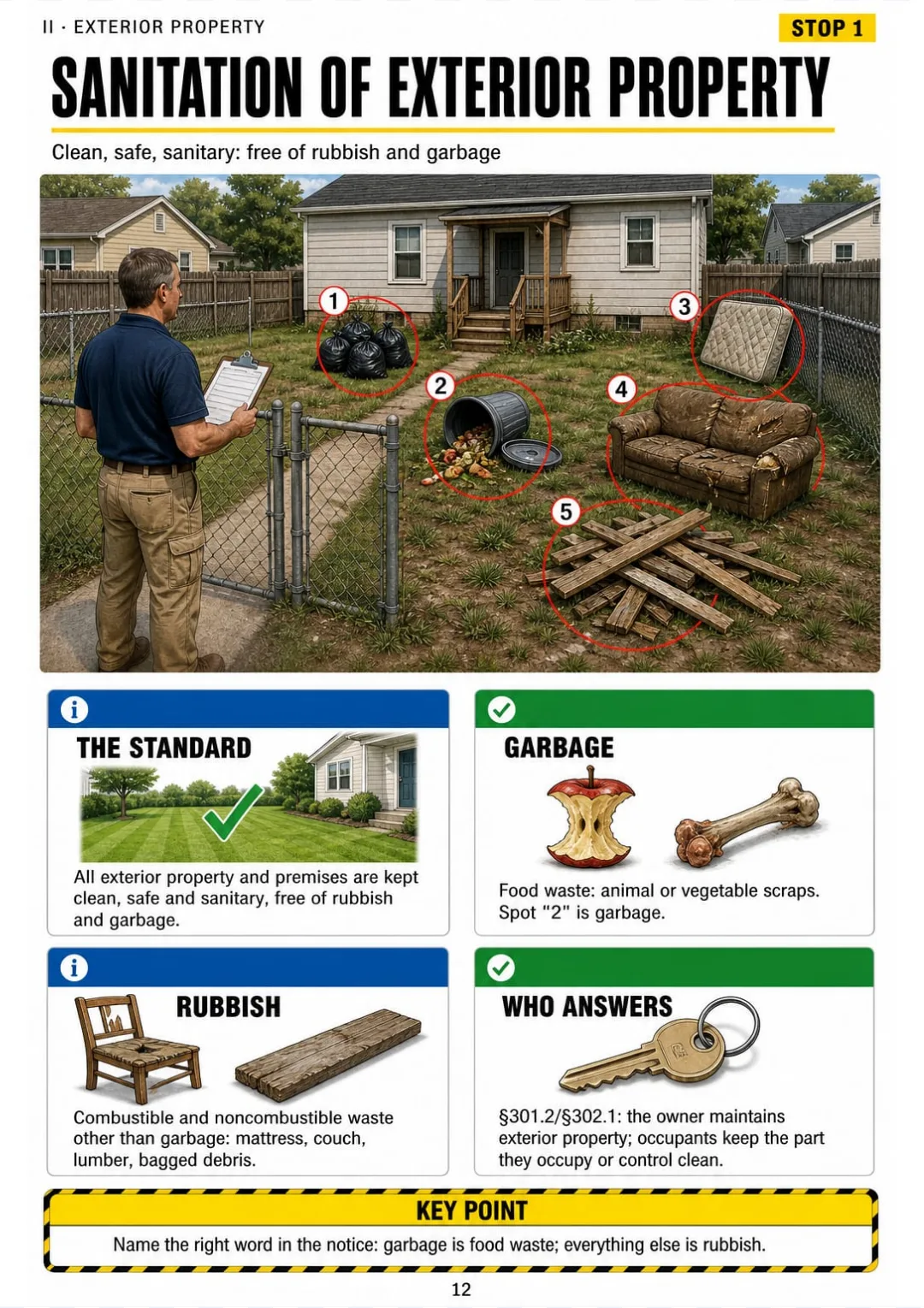
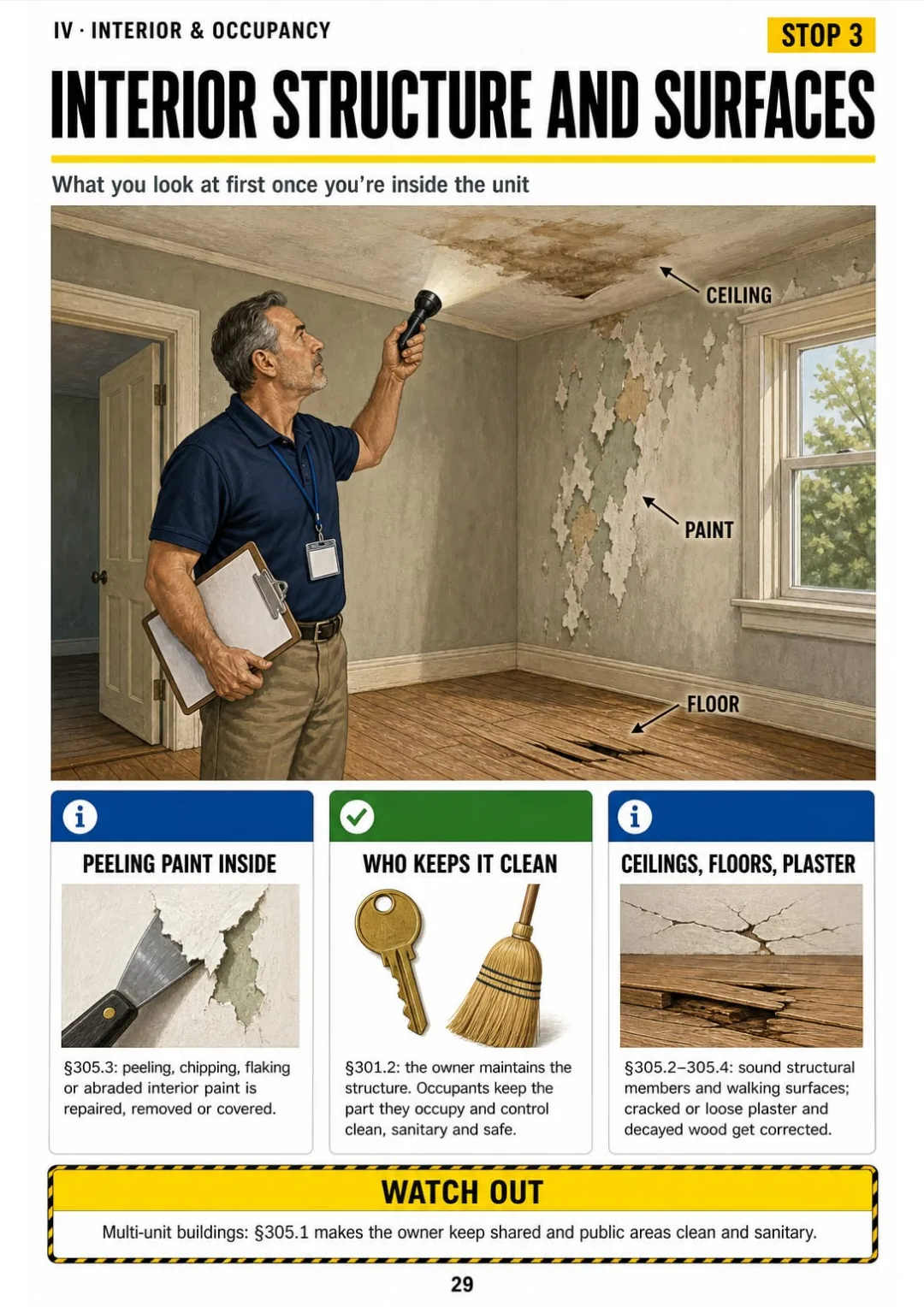
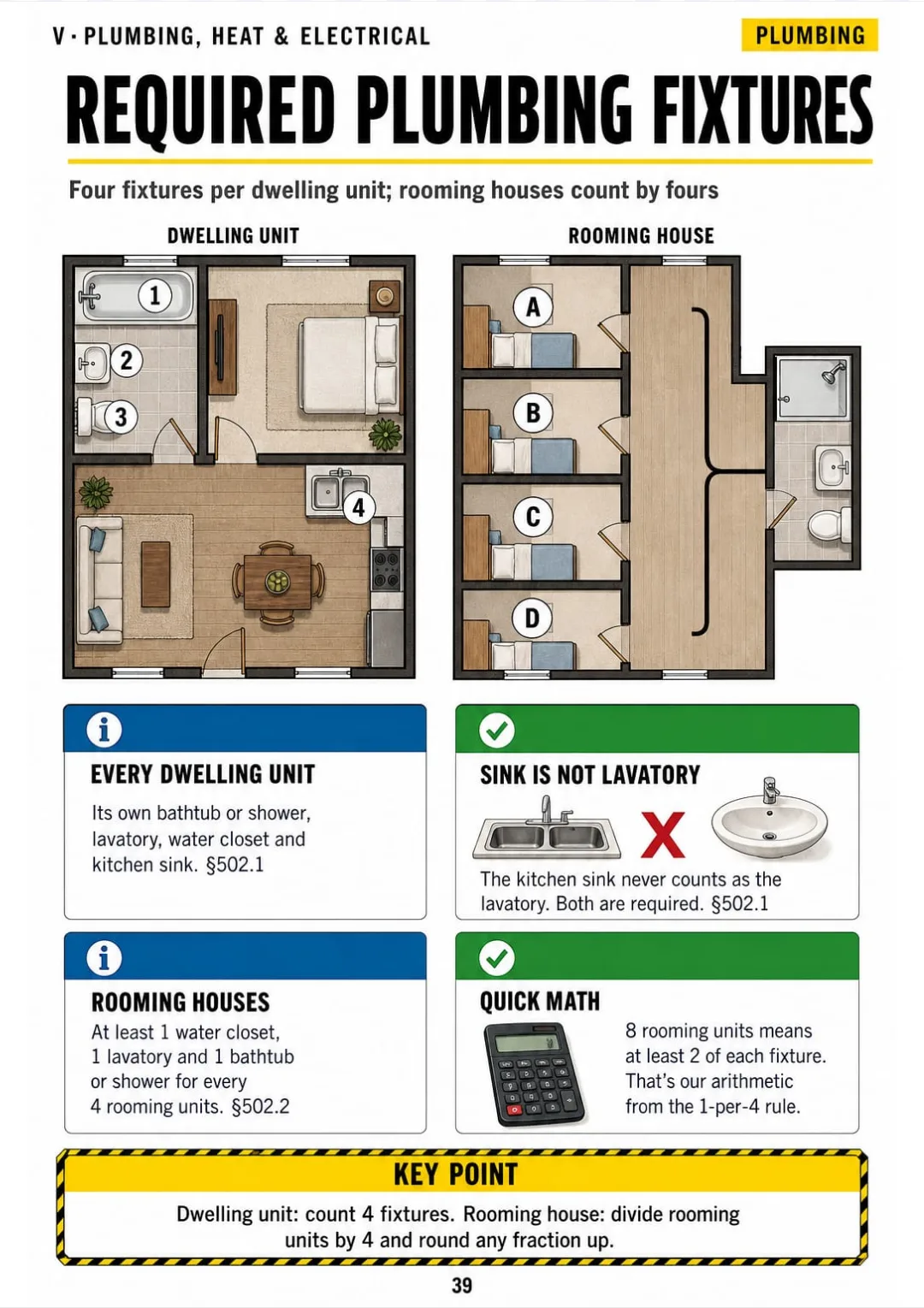
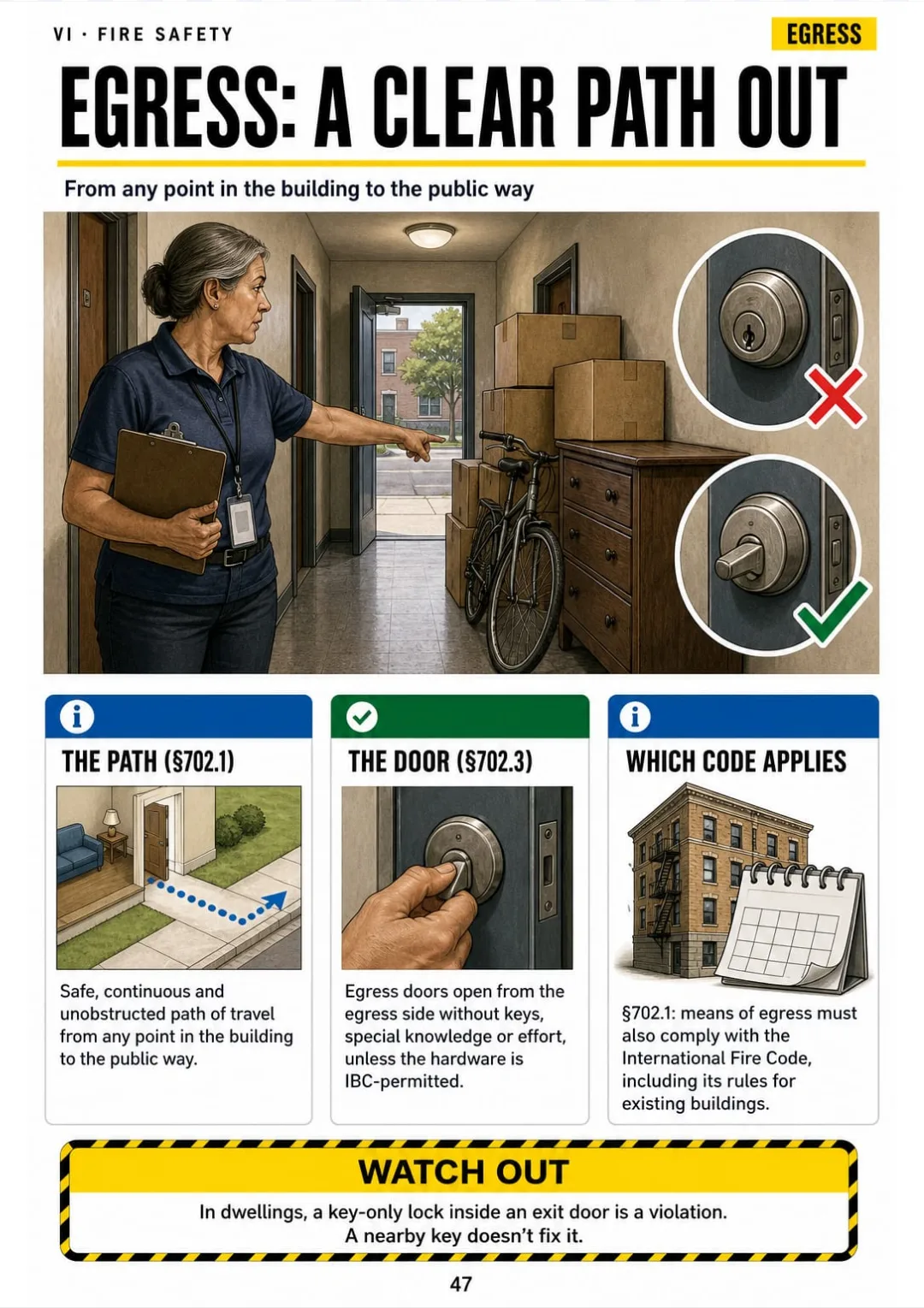
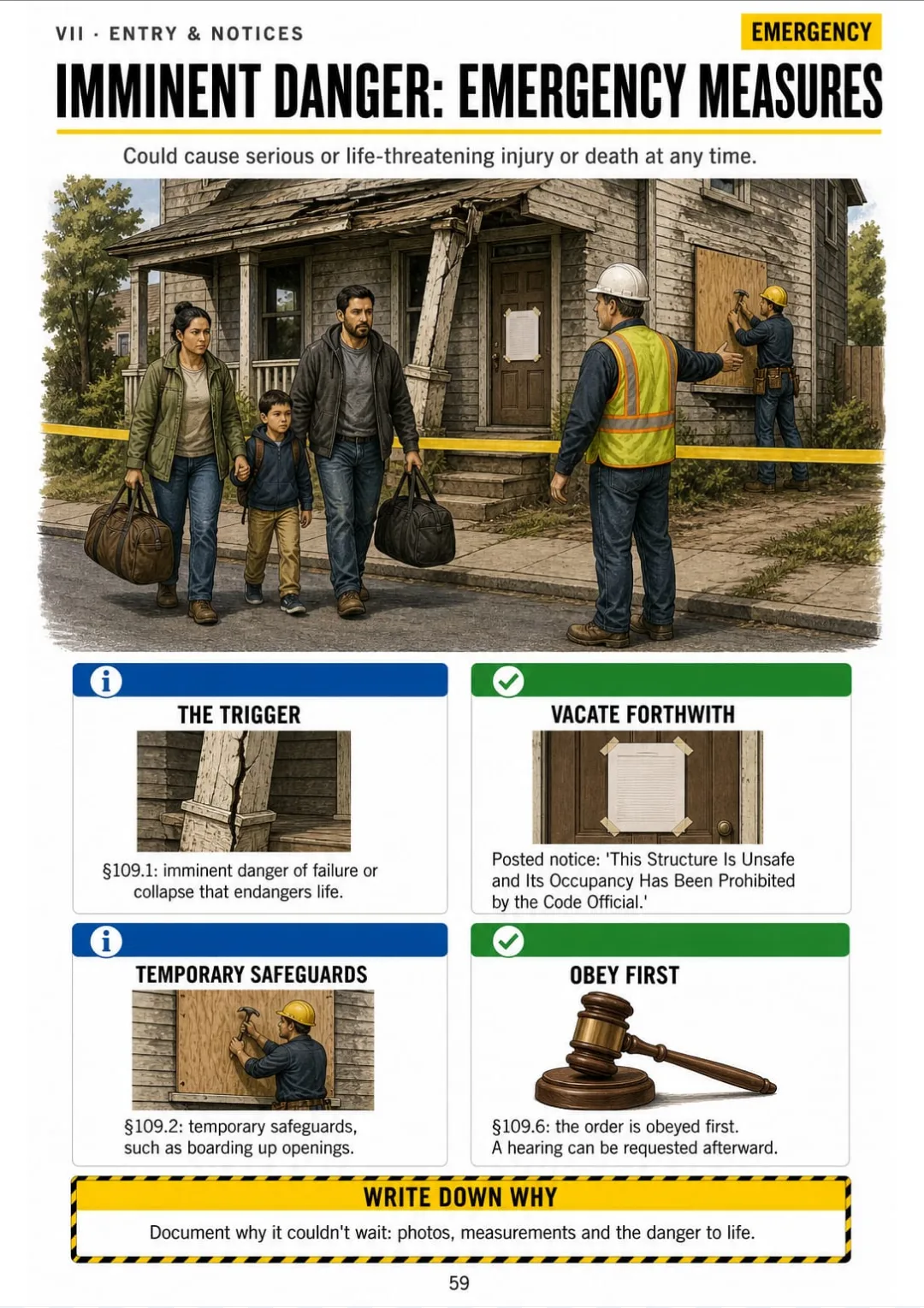
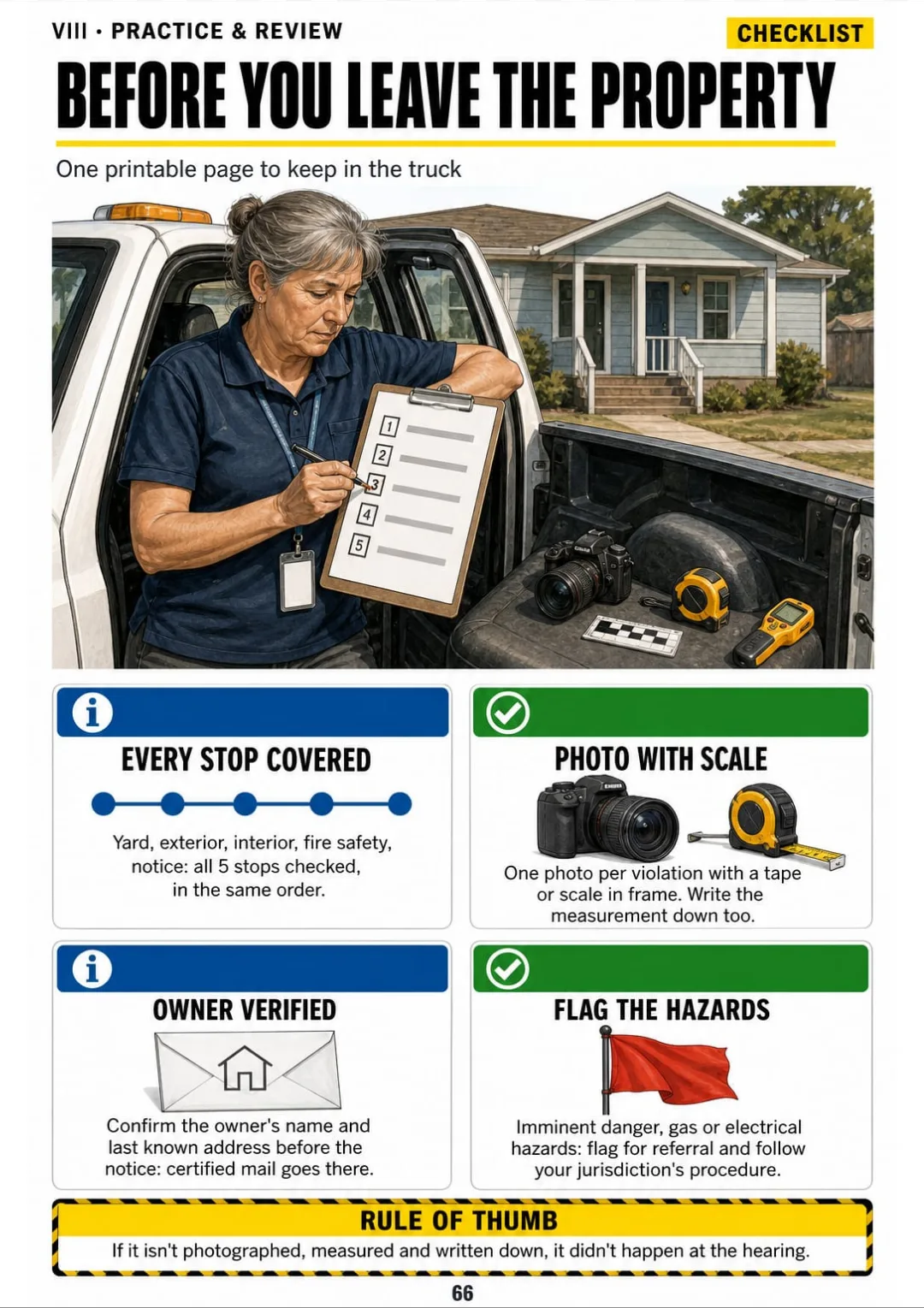
Every page has one big drawing and a box with the numbers and code sections you need to know:


Swipe to see more →
These are real pages from the book. The table of contents is the full one: 8 parts and 62 topics.
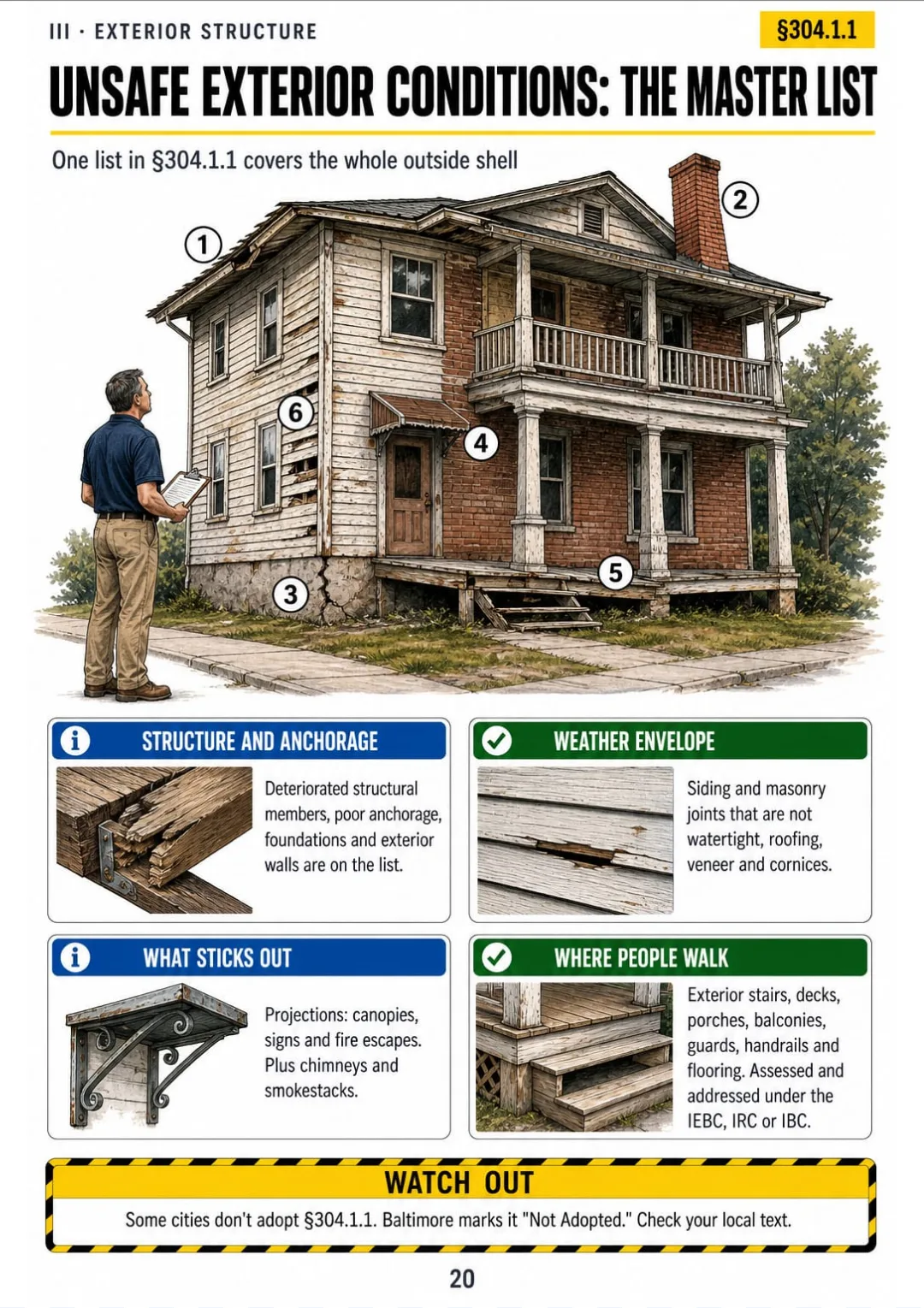
You're standing in front of a house with a sagging porch, a leaning chimney and a cracked foundation wall. The owner is on the steps, asking what exactly is wrong.
You know the code has a list of potentially unsafe exterior conditions. But in the code book it's one long run of items with nothing to hold onto, and on the sidewalk you can't come up with more than three of them.

In the book, that same section is one page: §304.1.1 drawn as one building, with the 12 conditions marked on it, from the foundation to the roof, plus a note on whether the repair falls under the IEBC, the IRC or the IBC.
Same with handrails and guards, emergency escape openings, smoke alarms, the occupancy table and the notice of violation: each one has its own page.
So you walk the house, you name what you see, and when the owner's attorney asks why you cited that section, you can picture the page it's on.

8 parts, in the order you walk a property: I. How the code works · II. Exterior property · III. Exterior structure · IV. Interior, light and occupancy · V. Plumbing, heat and electrical · VI. Fire safety and egress · VII. Entry, notices and hearings · VIII. Practice and review. 66 pages, all illustrated.
Think of it this way:
It's January. A tenant calls about no heat, the landlord is on the phone, and you're in the unit with a thermometer, needing to know where to hold it and what number counts.
In the book you open the heat page and see the room drawn with the thermometer in the right spot and 68°F in a box, plus a reminder to check the number your city adopted.

Same with egress windows, a deck with no guard, the occupancy table, where smoke alarms go and the parts of a notice of violation: each one on its own page.
Code Enforcement Illustrated is 8 parts and 62 topics, all drawn, and it ends with a full rental walkthrough, all the numbers on one page and a final checklist.
What you see drawn, you don't have to memorize.
The model code vs. your city's code, the blanks your city fills in, the chapter map, owner vs. occupant, the key definitions, your powers and limits, and the 5-stop route.
Sanitation, grading and drainage, sidewalks and steps, weeds and high grass, rodent harborage, accessory structures and fences, inoperable vehicles and pool barriers.
The master list of unsafe exterior conditions, peeling paint, address numbers, foundations and walls, roofs and chimneys, stairs and decks, handrails and guards, windows, doors and screens, building security.
Interior surfaces, unsafe components, garbage and pests, natural light, ventilation, room width and ceiling height, bedrooms, the occupancy table with a worked example, and efficiency units.
Required fixtures, toilet room privacy, water supply and water heaters, drainage, heat measured the right way, fuel-burning equipment, electrical service, receptacles and extension cords.
A clear egress path, emergency escape openings, fire-resistance ratings and fire doors, smoke alarms, carbon monoxide alarms, fire protection systems and extinguishers.
Right of entry and consent, plain view, evidence, the parts of a notice, serving it, placarding and vacating, imminent danger, reinspection, liens and appeals, and testifying.
A full rental walkthrough, a worked notice of violation, all the numbers on one page, how to use the code book in an open-book exam, and a final checklist.
At the end of the book: A full rental walkthrough, a worked notice of violation, all the numbers on one page and a final field checklist.
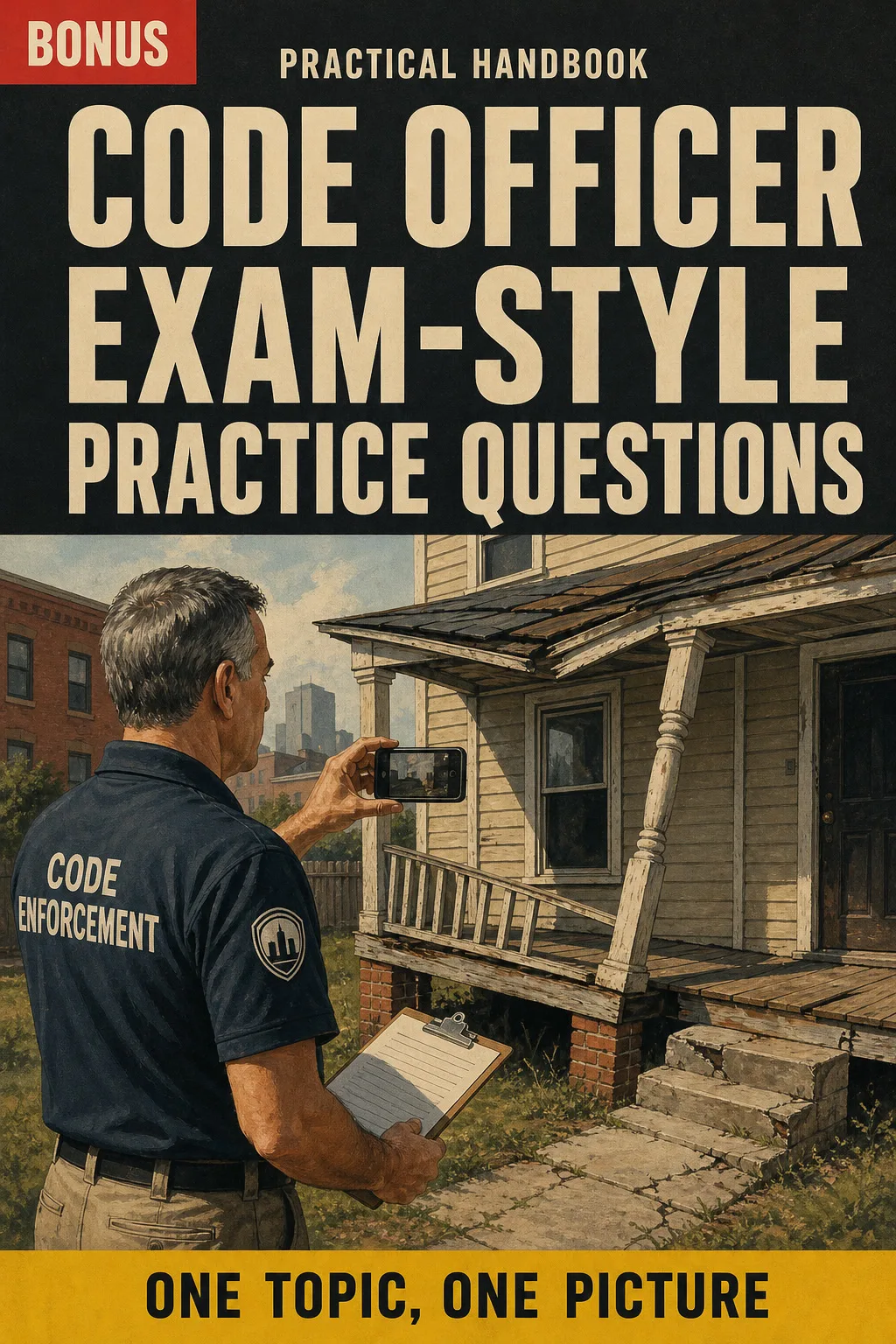
Practice with exam-style questions on every chapter, each answer explained with the page where the topic is drawn, so you know exactly what to review.

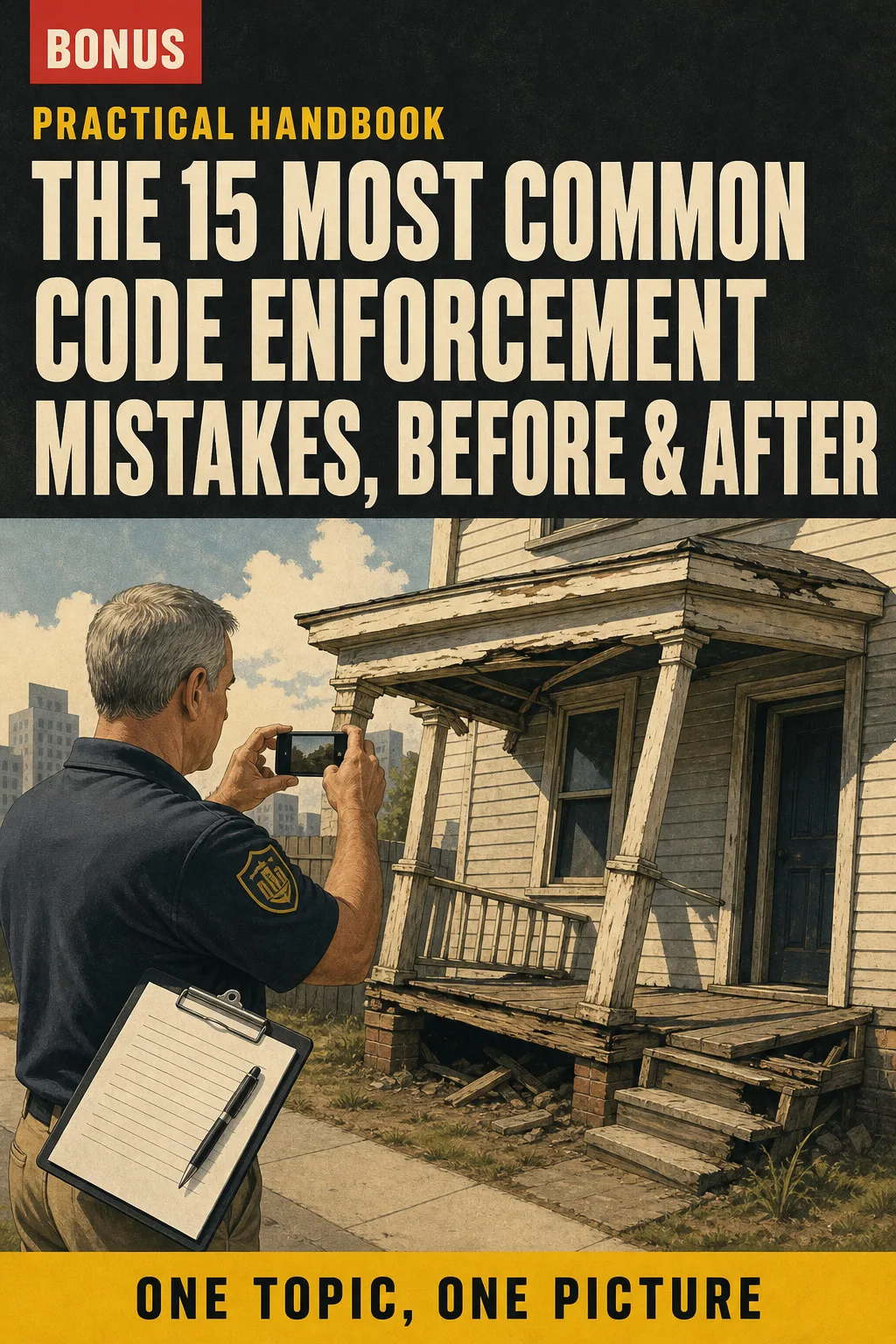
See the mistakes that get notices thrown out or cases delayed, drawn side by side with the right way, so you catch them before the hearing.
📄 This is a digital PDF book sent to your email: nothing is printed or shipped.
PDF by email: We email you Code Enforcement Illustrated as a PDF, together with the two free books. It's a single payment: no installments, no extra charges.
You came from police, fire, construction or city hall, and now the city wants you certified. Every chapter of the property maintenance code is drawn in the same route you walk in the field.
You review the whole syllabus in order, check every number on one page and practice with exam-style questions that send you back to the page where each topic is drawn.
Years on the job, and the hearing still makes you nervous. Each section is one page you can print, keep in the truck and check before you write the notice.
📄 This is a digital PDF book sent to your email: nothing is printed or shipped.
Try Code Enforcement Illustrated for 30 days, bonus books included.
We refund everything if the file won't open, if the book isn't what you see here, if you were charged twice or if the email doesn't arrive. Just email us.
You pay once. No subscriptions.
Yes. It isn't a beginner's intro. Keep your code book for the exact wording: this gives you the map. Each section is drawn on one page, in the order you walk a property, with the numbers in a box, so you can review fast, fill the gaps and check a section before you write the notice.
From the 2024 model edition of the International Property Maintenance Code (IPMC), published by the ICC, and every value is cross-checked against it. Your exam bulletin tells you which edition your exam uses, and your city may enforce an earlier edition or local amendments. That's why Part 1 shows you the blanks each city fills in and where to find your city's version, and the book flags the numbers cities often change so you can check them against your own code.
No. It's independent study material, not published by or affiliated with ICC, AACE or any exam body, and it doesn't come with a certificate or continuing education credits. It doesn't reproduce the code text: it explains it with its own words and drawings.
No. It's a study and review aid. It doesn't replace the training your city requires, the adopted code you enforce or legal advice from your city attorney.
No. They're exam-style questions written for this book, not official exam questions. Each answer points to the page where the topic is drawn.
As a PDF by email, sent to the address you enter at checkout. The 2 bonus books come as PDFs in the same email.
No. It's a one-time payment. No subscription.
Yes, you can print it: the whole book, or just the pages you want to keep in the truck.
You have 30 days. We refund everything if the file won't open, if the book isn't what you see on this page, if you were charged twice or if the email doesn't arrive: just email us.
No more rereading sections that don't stick.
Guards, egress windows, smoke alarms: you see them drawn and you've got it.
You walk into the exam, and the hearing, knowing where everything is.
Drawings make studying faster.
The book is right below.
One-time payment: US$ 27 · Guarantee: 30 days · PDF by email
YES, I WANT CODE ENFORCEMENT ILLUSTRATED FOR US$ 27📄 This is a digital PDF book sent to your email: nothing is printed or shipped.